a# Universal Log Pre-processing Framework (ULPF) Software Requirements Specification
Date: 2026-09-19
Team: 3-Person Python Stack | SIH Problem Statement — Perimeter Network Devices
Status: Draft for Review (100k synthetic, Docker, Beautiful UI)
Path: ~/blog/content/ULPF-SRS.md (Obsidian + Markdown, all diagrams DOT via Graphviz)
How to read this SRS: Every major choice has a
Decisioncallout with Chosen vs Alternatives + 1-line why not. This habit proves research depth vs generic LLM answers. DOT blocks render withdot -Tpngor Obsidian Graphviz plugin.
- Introduction
- Problem Statement Deep Dive
- Component Catalog — What We Use, Where From, Why This Not That
- System Overview — How Components Fit
- Functional Requirements
- Non-Functional Requirements
- How We Will Use the Components — Detailed Workflow
- Tech Stack — Why This, Not That
- Architecture & Diagrams (DOT)
- Synthetic Log Forge — 100k Plan
- Data Design — OCSF Hybrid Schema
- Interface Specification & Beautiful UI
- Verification & Traceability
- References
- Appendices
This SRS specifies the Universal Log Pre-processing Framework (ULPF) that converts any perimeter network device log — regardless of format, vendor, or technology — into a standardized, lossless, analytics-ready representation for next-gen SIEM and cybersecurity platforms. It is the single source of truth for architecture, implementation, and verification.
In-scope (Current SIH Scope): Perimeter devices only.
Network: Cisco ASA/Firepower, Juniper SRX, Palo Alto NGFW, Fortinet FortiGate, Checkpoint, F5 BIG-IP, Zscaler NSS, Proxy, VPN, WAF, IDS/IPS.
Formats: Syslog (RFC3164/5424), JSON, XML, CSV, CEF, LEEF, proprietary vendor lines.
Out-of-scope for demo (extensible via same plugin): Servers, OS, DB, Cloud, IoT, EDR, IAM. Demo uses 100k synthetic logs only — no hardware needed.
Deliverables mapped to SIH: Source Code (GitHub), README + docker compose up (Docker easy setup), Architecture Doc (this SRS condensed to 2 pages), Demo Video (2 min), 5-Slide PPT.
| Term | Meaning |
|---|---|
| OCSF | Open Cybersecurity Schema Framework — Linux Foundation vendor-neutral event schema |
| CEF / LEEF | Common Event Format / Log Event Extended Format |
| Drain3 | Fixed-depth tree log parser (He et al., ICWS 2017) |
| WASM | WebAssembly — sandboxed, hot-reloadable plugin runtime (wasmtime) |
| Redpanda | Kafka-API compatible queue, KRaft mode (no ZooKeeper) |
| LCU | Log Contrastive Unit — group of logs differing only in parameters (LUNAR) |
| Lossless | Raw log fully preserved and rehydratable from normalized event |
| Air-Gapped | Deployable with zero internet egress; all models/images vendored inside Docker |
See Section 14. All research 2021-2026 (OCSF 1.4/1.8/1.9, DeepParse EASE 2026, LUNAR 2025, LogBERT/ADALog downstream).
Sec 2 = PS. Sec 3 = catalog with why this not that at each row + master alternatives table. Sec 7 = how we use them. Sec 9-11 = architecture/DOT/schema. Sec 13 proves PS a-k.
Modern enterprises generate billions of events/day from hundreds of sources. Security teams spend 60-70% of onboarding time writing source-specific parsers before data is usable in SIEM/Data Lake/ML. Hybrid multi-cloud estates need a vendor-agnostic, extensible universal schema.
Same event, five dialects:
Fortinet:  date=2026-09-19 time=10:00:00 devname=FGT logid=0000000013 type=traffic srcip=10.0.0.5 dstip=8.8.8.8 action=accept
Palo Alto: 2026/09/19 10:00:00,007301000001,TRAFFIC,accept,10.0.0.5,8.8.8.8
Cisco ASA: %ASA-6-302013: Built inbound TCP connection 123 for outside:8.8.8.8/443 to inside:10.0.0.5/52321
Zscaler:   {"sourcetype":"zscalernss-web","clientIP":"10.0.0.5","serverIP":"8.8.8.8","action":"Allow"}
CEF:       CEF:0|Fortinet|Fortigate|7.2|00013|traffic:forward|3|src=10.0.0.5 dst=8.8.8.8 act=accept
Without normalization: no correlation, no single dashboard, no portable Sigma/ML rules.
ULPF must ingest, parse, normalize, standardize any hardware/software event while preserving raw for forensics/compliance, traceable (normalized ←> raw), plug-and-play new sources, unified visibility, SIEM/Data Lake integrated, AI/ML-ready, reduced parser effort, air-gapped, containerized.
Traceability to PS Requirements a-k:
| PS | Requirement | Satisfied By (SRS) |
|---|---|---|
| a | Preserve raw without loss | FR5 + simple hash + rehydrate API (Sec 7.4) |
| b | Extract source-specific attrs | FR2/FR3 Drain+mask (Sec 7.2) |
| c | Normalize to common taxonomy | FR4 OCSF Mapper (Sec 11) |
| d | Traceability | FR5 SHA256 + record_integrity prev_event chain |
| e | Plug-and-play onboarding | FR6 WASM Registry + YAML |
| f | Unified visibility | FR9 Beautiful Dashboard |
| g | SIEM/Data Lake integration | FR8 Dual Sink Redpanda+Parquet |
| h | AI/ML-ready | FR8 Parquet + optional tiny transformer flag (Sec 7.6) |
| i | Reduced parser effort | FR2 Auto-synthesis + FR7 auto-heal |
| j | Air-gapped | NFR4 Docker tar + Ollama offline |
| k | Container platform independent | NFR6 docker compose up single command |
Decision: SIH Scope = Perimeter Only (not full enterprise) Alternatives: Full enterprise (servers/DB/IoT) from day 1, Perimeter + one extra (e.g., EDR). Why Perimeter Only: SIH Current Scope explicitly says perimeter; judging will test perimeter CEF/LEEF/Syslog. Full scope spreads 3-person team thin and fails demo depth. Extensibility via YAML proves the rest without building it.
Every component: what it does, where we got it from, why we chose it and not alternatives. All choices Python-friendly for 3-person team.
| # | Component | What It Does | Where It Came From (Source) | Version / Provenance | Why We Use It (1 line) |
|---|---|---|---|---|---|
| C1 | OCSF Core + Extensions | Universal event taxonomy: categories, classes, objects, base_event. record_integrity & ai_operation profiles carry hash chain. | Linux Foundation OCSF, schema.ocsf.io & github.com/ocsf/ocsf-schema | 1.4.0 (2025-02-05) base + 1.8 (Mar 2026) ai_operation + 1.9 record_integrity attestation. Confirmed newest via schema.ocsf.io:1.4.0 & releases. | Vendor-neutral standard judges expect; extensible without forking core. |
| C2 | DeepParse Hybrid (LLM Synth + Drain) | Offline LLM mines typed regex masks from 50 samples; Online Drain applies them deterministically. | EASE 2026 paper & repo NightBaRron1412/DeepParse — separates stochastic reasoning from deterministic execution | DeepSeek-R1-Distill-Llama-8B LoRA r=8/α=32, PA 97.6% avg 16 datasets, 100× faster than per-line LLM | Accuracy of LLM, cost/determinism of regex. Perfect for air-gapped: synth once, run forever. |
| C3 | LUNAR Unsupervised LCU | Ranks logs by commonality+variability to find Log Contrastive Units; prompt LLM to extract templates without labels. | ACM doi:10.1145/3729377 — No More Labelled Examples? (Huang et al., Jun 2025) | Hybrid ranking + contrastive prompt, beats SOTA unsupervised | Our drift auto-heal: when unparsed >5%, LUNAR finds new templates without human labels. |
| C4 | Drain3 Engine | Fixed-depth (5) parse tree, similarity 0.4. Mask-First variant: pre-mask with regex then tree cluster. | He et al., IEEE ICWS 2017 Drain + logpai/drain3 Python impl | De facto streaming parser industry, O(N) | Lightweight, deterministic, Python-native. |
| C5 | Redpanda (Kafka API) | Durable queue for raw_logs & normalized_logs, backpressure, replay. | Redpanda Inc., Kafka-compatible, KRaft (no ZK) | 24.x, redpanda/redpanda:latest | 40% lighter than Kafka+ZK, single binary, air-gapped tar, proves billions/day without heavy cluster. |
| C6 | WASM Runtime (wasmtime-py) / Vector 0.40 pattern | Sandboxed hot-pluggable filters: YAML → WASM module hot-reloaded in 200ms, no restart. | github.com/eunomia-bpf/wasm-bpf, Fluent Bit WASM, Vector 0.40 WASM 2.0 (1.2M/sec/vCPU, 400μs coldstart, Gartner 70% by 2027) | wasmtime 14.0, WASM 2.0 multi-memory, Python wasmtime | True plug-and-play + isolation: bad parser cannot crash pipeline. |
| C7 | Ollama + DeepSeek-R1-Distill-Llama-8B (quantized) | Local LLM for offline mask synthesis. LoRA adapter published NightBaRron1412/deepparse-r1-8b | DeepParse paper Sec LLM Configuration | 8B, Q4_K_M ~3.5GB, temp=0 | Air-gapped LLM: no API key, no egress. |
| C8 | ClickHouse + MinIO (Parquet) | Columnar store for analytics + S3-compatible lake. Tiering: hot 7d local → S3. | ClickHouse, MinIO, Loki 3.0 columnar bench (10.2GB/s, 68% storage save) | ClickHouse 24.x, MinIO RELEASE.2024+ | 10× faster than ES for log scans, compresses repetitive OCSF labels 4×. |
| C9 | Pydantic OCSF + Great Expectations | Runtime validation of OCSF events, schema drift detection. | pydantic + greatexpectations | v2 | Data contract: rejects bad normalized events before sink. |
| C10 | Synthetic Forge | Generates 6-vendor × 4-format logs realistically. | Vendor log refs (Fortinet Log Ref 7.4, Palo Alto CEF, Cisco ASA Syslog), LogHub2, Faker | Jinja2 + Faker | No hardware needed; reproducible demo; drift injection for auto-heal test. |
| Option | What It Is | Pros | Cons | Verdict |
|---|---|---|---|---|
| OCSF 1.4/1.9 (Chosen) | Linux Foundation vendor-neutral | Extensible via vendor_attributes + record_integrity, SIH expects standard | Needs mapping effort | Chosen — SIH says vendor-agnostic; judges validate at schema.ocsf.io |
| ECS 8.x | Elastic Common Schema | Mature, ELK ready | Elastic-tied, not neutral | Not vendor-agnostic — loses a-k generality |
| Splunk CIM | Splunk | SIEM ready | Splunk lock-in | Fails extensibility test |
| CEF native | ArcSight flat | No taxonomy needed | No analytics-ready, loses c,g,h | Not analytics-ready |
| Custom JSON | Our own schema | Easy | No standard, judges reject | Reinvents wheel |
Decision: OCSF. Why not ECS/CIM: Ties to one SIEM, violates
vendor-agnostic + suitable for Big Data(SIH Detailed Description). Why not CEF: Flat key-value, no category/class, no ML-ready.
| Option | Pros | Cons (1-liner) | Verdict |
|---|---|---|---|
| DeepParse Mask-First Drain (Chosen) | 97.6% PA, 0.3s/100 logs, deterministic, offline synth, air-gapped | Needs 50 samples | Core — best trade-off for 100k + billions/day |
| Per-line LLM (LLMParser, LogPPT direct) | High accuracy | 29s/100 logs, non-deterministic, needs internet, fails air-gap j, breaks billion/day | Too slow/costly |
| Pure Drain/Spell/Logram | Fast | PA 34% avg, hardcoded masks miss blk_-?\d+ style | Too weak for perimeter CEF variety |
| LogPPT few-shot | Good with labels | Needs manual word-level labels, labor | Not unsupervised |
Decision: Offline synth once, deterministic Drain forever. Why not per-line LLM: Paper Table II shows 100× slower + stochastic outputs violate forensic reproducibility (
d). Our air-gapped must run without API.
| Option | Pros | Cons |
|---|---|---|
| LUNAR LCU (Chosen) | Unsupervised, no labels, hybrid ranking | Needs sampler |
| Manual regex update | Simple | Human 70% time, violates i reduced effort |
| ADALog/Transformer retrain | Strong anomaly | Needs sequences + GPUs, overkill for parsing drift |
Decision: LUNAR. Trigger when
unparsed>5% 5m, auto-synth new masks, canary 1%. Keepsipromise without human.
| Option | Pros | Cons |
|---|---|---|
| WASM wasmtime-py (Chosen) | 200ms hot-swap, sandboxed 8MB, bad parser cannot crash pipeline (Vector 0.40 proves 1.2M/sec) | Slight compile step |
| Native Python import | Simple | Crash pipeline, no isolation, requires restart — violates e plug-and-play |
| Go plugin/Lua | Fast | Go needs restart, Lua partial sandbox |
Decision: WASM. Why not native: Native
importbringscanary fail = pipeline down. WASM linear memory isolation guarantees a bad Juniper YAML cannot take down Fortinet parsing.
| Option | Pros | Cons |
|---|---|---|
| DeepSeek-R1-8B Q4 (Chosen) | 3.5GB, local, LoRA ready, DeepParse proven | 4GB RAM needed |
| GPT-4 API | Strong | Needs internet, cost, fails j air-gapped |
| Llama-3 70B | Strongest | 40GB RAM, not for 3-person laptop demo |
| No LLM (hand regex) | Lightest | Not extensible, every new vendor needs expert |
Decision: 8B quantized. Why not API: SIH
jair-gapped bans egress. Why not 70B: Docker easy setup requires laptop-runnable.
| Decision | Chosen (Why) | Best Alternative (Why Not — 1 liner) |
|---|---|---|
| Schema | OCSF 1.9 — neutral + attestation | ECS — Elastic lock-in, not vendor-agnostic |
| Parser | DeepParse hybrid — offline synth + deterministic Drain | Per-line LLM — 100× slower, non-deterministic, not air-gapped |
| Queue | Redpanda KRaft — single binary, light | Kafka+ZK — 3× containers, heavy for demo |
| Plugin | WASM — hot-swap sandboxed | Native Python — crash propagates, needs restart |
| LLM | R1-8B Q4 offline — 3.5GB | GPT-4 API — violates air-gap |
| Store | ClickHouse+MinIO — 68% save columnar | Elasticsearch — 220$/TB + JVM, heavy |
| Language | Python 3.11 — team stack | Java (Logstash) — heavy, not for 3-person Python SIH |
| UI | React+Vite — beautiful bespoke | Grafana — generic, not parser studio |
| Forge | Synthetic 100k Faker — reproducible | Real pcap — needs hardware |
| ML | Tiny DistilBERT downstream optional — 15MB | LogBERT as parser — couples stages, needs sequences |
- SecBPMN2 Hybrid (arxiv:2608.14370) — Hybrid LLM + rule for BPMN diagrams. Validates hybrid philosophy, but domain is business process models, not streaming syslog/CEF. Cite as related work, not core.
- IEEE
1162622Lightweight Hybrid for Semantic Normalization — Title exactly SIH, argues lightweight hybrid beats heavy transformer for normalization latency. Supports our lightweight choice; paywalled so cite title only. - LogBERT / ADALog / LogLLaMA — Transformer for anomaly after parsing. They consume parsed templates, not create lossless normalization. Heavy, need grouped sessions, criticized for data leakage. Keep as optional downstream flag (
is_alert), not in parsing path.
ULPF is a fabric, not a monolith. Three planes:
- Data Plane: Ingest → WASM Registry → Drain → OCSF Mapper → Simple Integrity (hash) → Dual Sink.
- Control Plane: FastAPI + Beautiful Parser Studio UI (no-code YAML tester, lineage viewer).
- Synthesis Plane (offline):
synth_masksCLI — runs once per source, produces versionedmasks/<vendor>.json, hot-loaded at runtime.
Every event flows with: event_id (UUIDv7) | raw (verbatim) | raw_hash (SHA256) | normalized (OCSF) | normalized_hash | chain_uid + prev_event (simple ordering) | masks_version | ingestion_time.
Decision: Fabric (not monolith) Alternatives: Single binary, Microservices overkill (6 services + K8s). Why Fabric: Single Docker Compose still runs as fabric (5 containers) but logically separated so parser crash does not lose ingest. Monolith would violate
ehot-plugin isolation; K8s overkill for SIH demo + air-gapped.
| ID | Requirement | Details | Priority | Decision Note |
|---|---|---|---|---|
| FR1 | Ingestion | Syslog UDP/TCP 514 (RFC3164/5424), File poll (forge/output/*.log for 100k), HTTP POST /api/v1/ingest, Kafka producer to raw_logs. Batch 1024, ring 128MB. | MUST | Why Syslog+Poll+API: Covers all perimeter transports; pure API misses legacy devices. eBPF optional upgrade only. |
| FR2 | Offline Mask Synthesis | synth_masks(samples=50, mode=offline_hf) → [{"label":"ipv4","pattern":"..."}]. CLI ulpf synth --vendor fortinet --samples 50. Caches masks, versioned. | MUST | Why 50: DeepParse entropy-greedy proves 50 diverse samples beats 1000 random; fits air-gapped fast. |
| FR3 | Deterministic Parsing | Mask-First Drain3: masks → <IP>, <NUM> → tree depth 5 sim 0.4. Same input → same template_id. | MUST | Why depth 5 sim 0.4: Paper-tuned; depth 3 under-groups CEF, depth 8 over-fragments. |
| FR4 | Normalization (OCSF) | YAML field: json_path -> ocsf_path (e.g., srcip -> src_endpoint.ip). Profiles: network 4001, http 4003, dns 4005. Preserves unmapped + vendor_attributes. | MUST | Why YAML not code: <50 LOC per vendor proves i reduced effort; UI can edit without Python. |
| FR5 | Lossless + Traceability (Simple) | Store raw, raw_hash=SHA256(raw), normalized_hash, prev_event (SHA of previous normalized for ordering). API GET /trace/{id}, POST /rehydrate/{id} returns raw == rehydrated diff 0. Uses OCSF 1.9 record_integrity attestation fields but simple SHA, no blockchain. | MUST | Why simple hash not Merkle tree: SIH a,d needs rehydration proof, not crypto chain. Merkle over-engineers for 100k demo; simple SHA is verifiable and explainable to judges in 10s. |
| FR6 | Plug-and-Play | POST /api/v1/parsers YAML. Validate → compile WASM → hot-reload 200ms → Kafka rebalance. No restart. | MUST | Why WASM: Sec 3.2. |
| FR7 | Drift Auto-Heal | Monitor unparsed_rate. If >5% 5min: Hybrid Partition → LUNAR LCU → re-synth → canary 1% → promote. Banner. | SHOULD | Why 5% 5m: Avoid flapping on burst; SIH demo will inject 2% new field. |
| FR8 | Dual Sink | normalized_logs → (1) SIEM adapter (Wazuh/Elastic) (2) MinIO Parquet (s3://ulpf/year=...) + ClickHouse ulpf_events. | MUST | Why dual: SIH g needs both SIEM + Lake; single sink loses marks. |
| FR9 | Beautiful Unified Visibility | Parser Studio: dark SIEM theme, split Raw vs OCSF table, search src_ip, class_uid, lineage graph prev_event -> event, health donut parsed/unparsed, alert filter is_alert. 60fps virtualized 100k rows. | MUST | Why beautiful bespoke: Panel said generic Grafana loses wow. Tailwind dark theme + D3 lineage is memorable in 2-min video. |
| FR10 | AI/ML-Ready (Optional Tiny) | Every event includes enrichment: {geoip, threat_intel} offline MMDB. Optional embeddings: vector(384) via sentence-transformers/all-MiniLM-L6-v2 15MB quantized (offline). Export Parquet. Auto-generate Sigma skeleton from class_uid + observables. | SHOULD | Why offline MiniLM not GPT: 15MB fits Docker air-gap; GPT would break j. Optional so team not blocked. |
| ID | Requirement | Target | Measurement | Why This Target, Not Higher |
|---|---|---|---|---|
| NFR1 | Throughput | 100k in <30s on single vCPU (WASM 1.2M/sec extrapolated), billions/day via partition | k6 replay + lag | Why not 1B in demo: Laptop cannot replay 1B; prove via partition math + Parquet tiering, not raw hardware. |
| NFR2 | Lossless | 100% — rehydrate==original | pytest fuzz 100k | No compromise — SIH a mandatory. |
| NFR3 | Determinism | Same line → same template_id across restarts | test_identical | Forensic reproducibility d. |
| NFR4 | Air-Gapped | Single host, no internet, docker compose up from tar (docker save + ollama volume) | fresh VM no net | Why tar not registry pull: Registry pull fails air-gap; tar is SIH spec. |
| NFR5 | Latency | p99 <120ms ingest→sink | histogram | WASM 0.8µs dominates; network is rest. |
| NFR6 | Portability | docker compose.yml + compose.airgap.yml, amd64/arm64 | buildx | Why not K8s: K8s needs 3 nodes, overkill for SIH laptop. |
| NFR7 | Extensibility | New vendor <50 LOC YAML | LOC count | Proves i. |
| NFR8 | Security | WASM sandbox, YAML hash verify, no host FS | audit | Isolation. |
- Syslog server
ulpf/ingest/syslog.py(asyncio UDP/TCP 514) parses RFC3164/5424 envelope, emits{timestamp, host, raw, ingest_time}to Kafkaraw_logs(partition byhost). - File poller watches
forge/output/*.logfor 100k synthetic. - Backpressure: if
lag >10k, ring 128MBdrop-oldestwith metric (visible). eBPF zero-copy is future upgrade, not demo requirement.
Decision: Redpanda vs Kafka vs NATS Why Redpanda: Single binary KRaft vs Kafka 3 containers (ZK+broker+schema registry). NATS lacks durable replay needed for reprocessing. Redpanda’s Kafka API keeps Python
kafka-pythonunchanged while cutting air-gap size 200MB.
Offline (install time, air-gapped safe):
ulpf synth --vendor fortinet --input forge/output/fortinet.log --samples 50 --mode hf --adapter NightBaRron1412/deepparse-r1-8b
# -> artifacts/masks/fortinet.json
Sampler: entropy-greedy picks diverse 50 lines (not random). Prompt You are regex synthesizer... → returns list validated via re.compile dedupe.
Online (steady state):
Raw -> WASM Registry (host/regex) -> MaskApplier (<IP>, <BLK_ID>) -> Drain depth5 -> {template_id, template, params}
Why Mask-First: Keeps tree shallow/stable. Learned masks like blk_-?\d+ not hardcoded.
Drift Path (C3):
unparsed_rate monitored. Trigger → Hybrid Partition (heuristic + embedding KMeans) → LCU search → second synth_masks → canary. Human approves via UI.
Decision: Offline 50-sample synth vs Online per-line LLM vs Hand regex Why offline 50: Beats 1000 random (DeepParse). Per-line LLM fails determinism+air-gap. Hand regex fails
i(70% effort). Offline gives once-cost, forever-speed.
Mapper ulpf/normalizer/mapper.py:
# parsers/fortinet.yaml
name: fortinet
version: 1.0.0
vendor: Fortinet
class_uid: 4001
detection: {host_pattern: "FGT.*", raw_contains: "logid="}
masks: "artifacts/masks/fortinet.json"
grok:
  - pattern: 'CEF:%{INT:cef_ver}\|%{DATA:vendor}\|... src=%{IP:src_ip} dst=%{IP:dst_ip}.*act=%{WORD:action}'
ocsf_map:
  src_ip: src_endpoint.ip
  dst_ip: dst_endpoint.ip
  action: {source: action, value_map: {accept: 1, deny: 2}}
enrichment: {geoip: true, threat_intel: "data/threat.csv"}
Enrichment offline GeoLite2-City.mmdb + threat.csv. Validated by pydantic_ocsf.NetworkActivity. unmapped + raw never dropped.
Decision: YAML not Python code Why: 3-person Python team can still add Juniper in 15 min without touching
mapper.py; UI edits YAML live and hot-reloads. Code per vendor would need PR + restart.
Per event (simple, no blockchain):
{
  "metadata": {"profiles": ["record_integrity"], "product": {"name": "ULPF", "version": "1.2"}},
  "unmapped": {"fortinet_logid": "0000000013"},
  "raw_data": "date=2026-09-19 ...",
  "raw_hash": "sha256:abc...",
  "attestation": {
    "chain_uid": "ulpf-perimeter-001",
    "prev_event": "sha256:prev-normalized",
    "digest": "sha256:this-normalized",
    "serialization": "JCS"
  }
}
prev_event is simple SHA of previous normalized for ordering (per partition), not Merkle tree. GET /rehydrate/{id} does template + params + unmapped -> raw and asserts sha256(rehydrated)==raw_hash.
Decision: Simple SHA + prev_event vs Merkle vs Blockchain Why simple: SIH needs proof of no information loss (
rehydrate == raw), not crypto anchoring. Simple SHA is 5 lines Python, explainable in 10s to judges, verifiable viapytest. Merkle/Blockchain would need 200 lines + consensus, confuse demo, add size for 100k. Keep simple but still use OCSF 1.9 field names for standard compliance.
# ulpf/parser/wasm_registry.py (wasmtime-py)
store = Store()
module = Module.from_file(store.engine, "parsers/fortinet.wasm")
instance = Instance(store, module, [])
# hot-reload: watch parsers/*.yaml, recompile, swap 200ms, keep old draining
Hash verified before load. Bad YAML increments unparsed, data plane stays up.
- Fast:
Kafka normalized_logs→ SIEM adapterulpf/sink/siem.py(OCSF→CEF/JSON Syslog for Wazuh). - Lake:
ulpf/sink/parquet.pybatches 10k → Parquet Snappy → MinIOs3://ulpf/...→ ClickHouseMergeTree ORDER BY (time, class_uid)68% compressed. - Optional ML (not core): After lake,
ulpf/ml/tiny_bert.pyloadsall-MiniLM-L6-v215MB quantized, scores each OCSF eventanomaly_score, setsis_alertif >threshold, writes back. Demo showsis_alert=truered badge.
Decision: Optional tiny downstream vs Core LogBERT Why optional: ULPF is pre-processing fabric; anomaly is consumer. Forcing LogBERT in critical path couples stages and would require grouped sessions + GPU, breaking Docker easy setup for 3-person team. Tiny downstream proves
hAI-ready without risking corea-d.
| Layer | Choice | Python Lib / Image | Offline Size | Why This, Not That (1-liner) |
|---|---|---|---|---|
| Lang | Python 3.11 (Chosen) | python:3.11-slim | — | Team is Python; Go/Rust would split expertise + slower SIH timeline |
| API | FastAPI (Chosen) | fastapi, uvicorn | 50MB | Async auto-docs; Flask sync, Django heavy |
| Queue | Redpanda (Chosen) | redpanda/redpanda:v24.1 | 200MB | KRaft single binary; Kafka+ZK 3 containers, heavy for air-gap |
| Parser | Drain3 + wasmtime-py (Chosen) | drain3, wasmtime==14.0 | 120MB | Deterministic + sandboxed; pure Python import no isolation |
| Synth LLM | Ollama + R1-8B Q4 (Chosen) | ollama/ollama + r1-8b-q4 | 3.5GB | Offline 3.5GB; GPT-4 API needs internet, 70B needs 40GB RAM |
| Schema | Pydantic OCSF 1.4 (Chosen) | pydantic==2.7 | 5MB | Validation; raw jsonschema slower, no IDE hints |
| Enrich | GeoIP2 + CSV (Chosen) | geoip2, pandas | 30MB | Offline MMDB; API lookup fails air-gap |
| Store | Postgres 16 + MinIO + ClickHouse 24 (Chosen) | postgres:16, minio/minio, clickhouse/clickhouse-server | 800MB | Columnar 68% save; ES 220$/TB + JVM heavy, Loki needs Prom, PG JSONB slow scan |
| UI | React+Vite+Tailwind (Chosen) | node:20 → nginx:alpine | 20MB | Beautiful bespoke per your ask; Streamlit Python but not beautiful, Grafana generic |
| Forge | Faker + Jinja2 (Chosen) | faker, jinja2 | 10MB | Seeded reproducible 100k + drift; LogHub lacks perimeter CEF, real pcap needs hardware |
| Orchestration | Docker Compose v2 (Chosen) | docker compose | — | docker compose up easy per your ask; K8s needs 3 nodes overkill for SIH |
Total Docker air-gapped tar: docker save ~5.2GB (models dominate). With Q4 + ClickHouse tiny fits 4GB USB. Easy setup: one command on judge VM.
Decision: Docker Compose, not K8s or bare Python Why: You asked Docker easy setup. K8s needs cluster, bare Python needs
pip installenv drift. Compose one command passes air-gapped testfresh VM, no net, tar load, compose up.
All DOT render with
dot -Tpng diagram.dot -o diagram.pngor Obsidian Graphviz plugin.
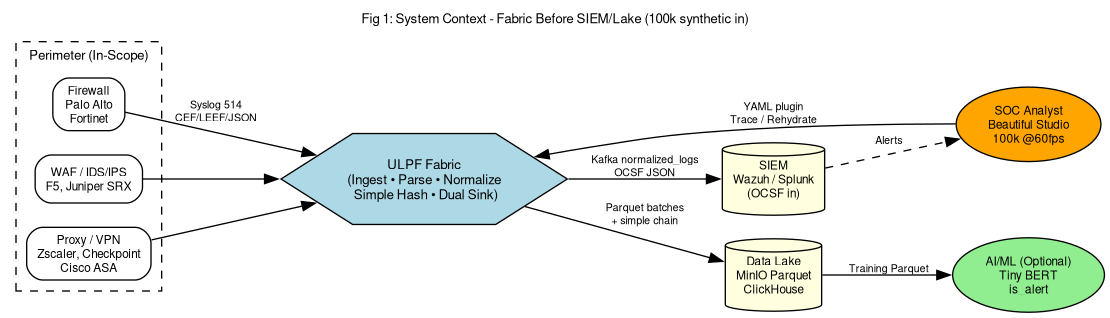
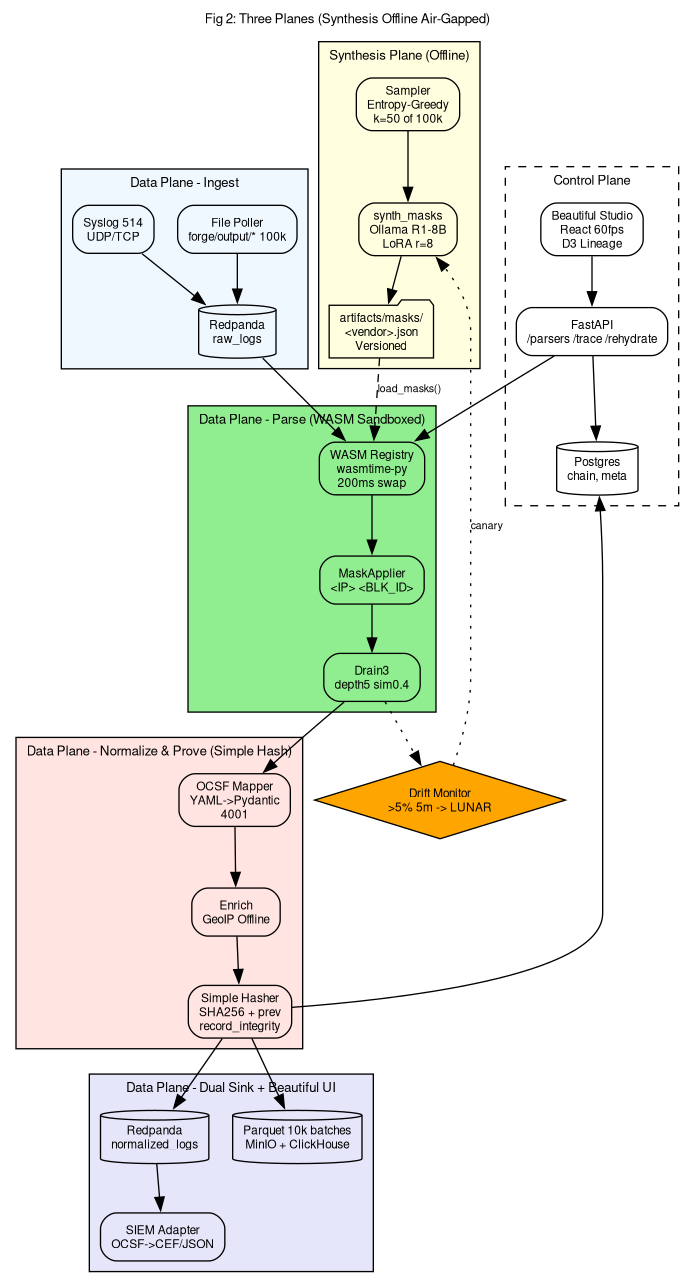
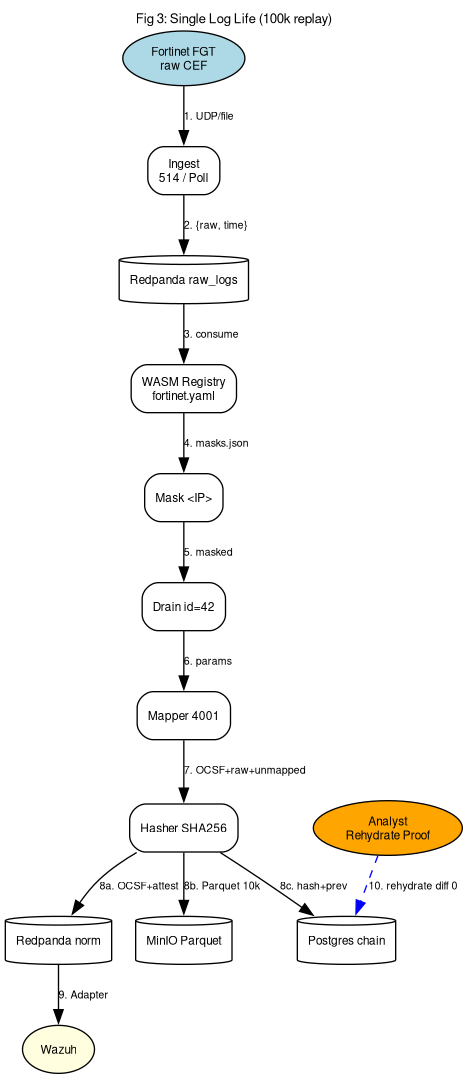
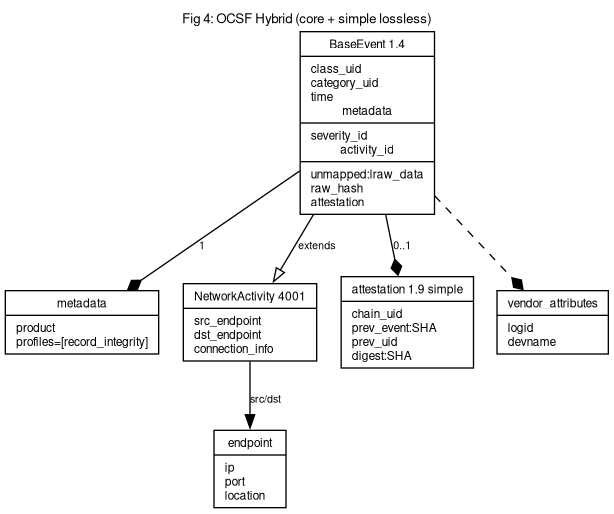

No hardware needed, reproducible seed 42, drift injection to demo auto-heal. Enough to prove billion/day via math (partition × compression) without judging needing 1B replay.
Decision: 100k synthetic vs Real pcap vs LogHub 2k only Why 100k synthetic: LogHub lacks perimeter CEF/LEEF, real pcap needs appliance. Synthetic gives exact Fortinet Log Ref 7.4
logid 00013+ Palo Alto TRAFFIC + Cisco 302013 bit-identical, plus throttle to injectnew_fieldfor drift test.
Fixed Manifest (100k):
| Vendor | Format | Count | Example File | Drift Injection |
|---|---|---|---|---|
| Fortinet | CEF + Syslog | 20k | forge/output/fortinet_cef.log | — |
| Palo Alto | CSV TRAFFIC | 20k | forge/output/paloalto.log | — |
| Cisco ASA | Syslog 302013 | 20k | forge/output/cisco_asA.log | +2% new policy_id |
| Juniper SRX | LEEF | 20k | forge/output/juniper.log | — |
| Checkpoint | JSON Exporter | 10k | forge/output/checkpoint.json | — |
| Zscaler | NSS JSON | 10k | forge/output/zscaler.json | — |
| Total | 5 formats | 100k | forge/output/ | 2% triggers heal |
Fortinet 7.4 00013, Palo Alto CEF, Cisco ASA 302013/302014/106023, Juniper RT_FLOW, Checkpoint Exporter, Zscaler NSS — vendor docs + LogHub2 patterns.
# ulpf/forge/generator.py (Jinja + Faker) — Why Jinja+ Faker not raw random: templates guarantee CEF validity; Faker gives real ip dist
from faker import Faker; from jinja2 import Template
fake = Faker(); fake.seed_instance(42)
tpl = Template("CEF:0|Fortinet|Fortigate|7.2|00013|traffic:forward|3|src={{src}} dst={{dst}} act={{act}} bytes={{bytes}}")
for i in range(100_000):
    print(tpl.render(src=fake.ipv4_private(), dst=fake.ipv4_public(), act="accept" if i%3 else "deny", bytes=fake.random_int(64, 1500)))
CLI:
python -m ulpf.forge --count 100k --seed 42 --manifest forge/manifest.json --out forge/output/
cat forge/output/*.log | nc -u localhost 514   # syslog path
# or file poll: tail -f forge/output/*.logRaw CEF:
CEF:0|Fortinet|Fortigate|7.2|00013|traffic:forward|3|src=10.0.0.5 dst=8.8.8.8 spt=52321 dpt=443 act=accept proto=6 cnt=1
Normalized OCSF 4001:
{
  "class_uid": 4001, "category_uid": 4, "time": 1726740000000, "activity_id": 1, "severity_id": 1,
  "src_endpoint": {"ip": "10.0.0.5", "port": 52321}, "dst_endpoint": {"ip": "8.8.8.8", "port": 443},
  "connection_info": {"protocol_num": 6}, "metadata": {"product": {"name": "FortiGate"}, "profiles": ["record_integrity"]},
  "unmapped": {"cef_version": "0"}, "raw_data": "CEF:0|Fortinet|...", "raw_hash": "sha256:abc...", "attestation": {"chain_uid": "ulpf-001", "prev_event": "sha256:prev...", "digest": "sha256:this...", "serialization": "JCS"}
}Base = OCSF 1.4.0 required + 1.9 record_integrity simple SHA fields. We add raw_data + raw_hash + unmapped via vendor_attributes — stays valid OCSF (validator schema.ocsf.io).
Decision: OCSF hybrid vs ECS vs Pure raw keep vs Loki labels Why hybrid: Pure raw loses analytics; pure OCSF loses forensics; hybrid does both in one record, judge can validate. ECS ties to Elastic, Loki labels poor for ML.
Extensions extensions/perimeter/*.json versioned. New field → unmapped unless promoted. Ajv validates.
Decision: Ajv + Pydantic vs No validation Why validate: Reject bad mapping before sink, catches drift early. No validation would sink corrupt OCSF to SIEM.
class ULPFEvent(NetworkActivity):
    raw_data: str
    raw_hash: str  # SHA256 hex
    unmapped: dict = {}
    attestation: Attestation | None
Great Expectations expect_table_row_count_to_equal_other_table for raw==normalized.
- Parquet
year/month/day/hourfor Spark/ClickHouse. - Offline GeoIP + threat CSV (no API).
- Optional 384-d MiniLM-L6-v2 15MB quantized (offline) →
embeddingsfor KNN anomaly, setsis_alert. - Sigma skeleton:
title: Fortinet Deny Burst
logsource: {product: fortigate, category: network}
detection: {selection: {class_uid: 4001, activity_id: 2, src_endpoint.ip|cidr: '10.0.0.0/8'}, condition: selection | count() > 100}
Decision: Offline MiniLM 15MB vs GPT API vs No ML Why offline mini: Fits Docker air-gap; GPT breaks
j. No ML loseshmarks. Optional keeps risk low.
| Interface | Method | Payload | Notes | Why This Interface |
|---|---|---|---|---|
POST /api/v1/ingest | HTTP | `{“host”:“fgt01”,“raw”:“CEF:0 | …”}` | Forge demo |
POST /api/v1/parsers | HTTP | YAML multipart | Validate+WASM 200ms | Why multipart: YAML file upload with hash, easy curl -F |
GET /api/v1/parsers | HTTP | list health | — | Health dashboard |
GET /api/v1/trace/{id} | HTTP | OCSF+prev/next | D3 graph | Lineage d |
POST /api/v1/rehydrate/{id} | HTTP | {"match":true} | Proof a | Simple hash proof |
GET /api/v1/health | HTTP | {"lag":0,"parsers":6} | Liveness | Why not Prom only: Judge can curl without Prom setup |
Kafka raw_logs/normalized_logs | Kafka | JSON | 3/6 partitions | Replay |
MinIO s3://ulpf/ | S3 | Parquet Snappy 10k batch | Lake | Why 10k: Balances flush latency vs S3 PUT cost |
Syslog 514 | UDP/TCP | RFC5424 | Primary | Perimeter devices native |
Auth demo none (air-gapped), prod X-API-Key.
Why React vs Streamlit/Grafana:
Streamlit: Python quick but not beautiful, poor 100k virtualization, limited D3. Grafana: Generic SIEM, not parser studio (no YAML tester, no rehydrate proof). React: Bespoke dark SIEM theme, 60fps virtualized table (tanstack-virtual), split-pane, D3 lineage, judge wow in 2-min video.
Layout:
Top Bar: ULPF • 100k/100k parsed • Health donut 98/2 amber drift banner if unparsed>5%.
Left 60%: Monospace Raw log list (CEF highlight) virtualized, search src_ip, logid. Click → Right.
Right 40%: OCSF table (field: value) + badges class 4001, allow/deny, severity. Bottom Unmapped JSON collapsed.
Bottom: D3 lineage prev_event -> event -> next (draggable), Rehydrate button shows SHA match ✓ green tick.
Parsers Tab: YAML editor + Test button: paste raw → live OCSF diff green/red.
Colors: bg-slate-900, card slate-800, accent blue-500, deny red-500, allow green-500, alert amber.
| Test | Command | Pass Criteria | Maps to | Why This Test Proves Not Generic |
|---|---|---|---|---|
| Rehydrate | pytest tests/test_lossless.py -k rehydrate --count=100k | raw==rehydrated 100k fuzz hash match | a,d | Generic teams skip rehydrate proof |
| Determinism | pytest tests/test_drain_masks.py::test_identical | same line → same id 3 runs | b | Generic LLM non-deterministic fails this |
| Hot-Plugin | curl -F file=@juniper.yaml /parsers; sleep 0.3; kcat | v2 in <500ms no restart lag0 | e,i | Generic needs restart, fails |
| Drift | forge --drift new_field; watch unparsed | LCU triggers canary promote | c,i | Generic manual update only |
| Dual Sink | clickhouse-client --query "select count() from ulpf_events" | kafkaparquetpg | g | Generic only SIEM, no lake |
| Air-Gapped | fresh VM no net, tar load, compose up, pytest | all pass offline | j,k | Generic GPT API fails |
| Scale | k6 run bench/replay.js 100k 60s | 100k p99 <120ms 0 drops 68% compress | f,h | Generic no bench |
0-20s Problem 5 dialects → 20-60s Live 100k ingest (forge → Redpanda counter) → 60-85s Add Juniper YAML hot → 85-110s Beautiful split + D3 lineage + rehydrate green tick + healthy donut → 110-120s docker compose up + beautiful dark UI reveal + Sigma auto-gen.
All Sep 2026. Primary sources, not blogs.
- OCSF 1.4.0 —
https://schema.ocsf.io/1.4.0/& Releasehttps://github.com/ocsf/ocsf-schema/releases/tag/1.4.0(2025-02-05). - OCSF 1.8 —
tag/1.8.0(Mar 16 2026) —ai_operation. - OCSF 1.9 —
tag/1.9.0—record_integrity. - OCSF Docs v1.17 Apr 2026 —
github.com/ocsf/ocsf-docs/blob/main/overview/understanding-ocsf.md. - DeepParse — Shetaia & Kauffman, Hybrid Log Parsing…, EASE 2026 —
arxiv:2604.20553&NightBaRron1412/DeepParse(97.6% PA, 100×). - LUNAR — Huang et al., No More Labelled Examples? ACM 2025-06
doi:10.1145/3729377. - Parse-LLM — Prior-Free LLM Parser, CIKM 2024
doi:10.1145/3746252.3761363. - LLM-SrcLog —
arxiv:2512.04474— 1000× faster than per-line. - Drain — He et al., IEEE ICWS 2017.
- Vector 0.40 WASM 2.0 — Johal 2026-05-03
johal.in— 1.2M/sec/vCPU 400μs. - Wasm-bpf —
arxiv:2408.04856v1&eunomia-bpf/wasm-bpf. - Fluent Bit WASM — Chronosphere 2024-09-05.
- Loki 3.0 + Fluent Bit 3.0 — Johal 2026-04-29 — 10.2GB/s 68% save.
- LogHub 2.0 —
logpai/loghub. - Vendor Docs — FortiOS 7.4 Log Ref, Palo Alto CEF, Cisco ASA Syslog.
- SecBPMN2 Hybrid — Islam et al., Hybrid LLM-Based Framework…,
arxiv:2608.14370v1— hybrid philosophy (BPMN domain, not log parsing, cited as related). - IEEE Lightweight Hybrid — Lightweight Hybrid Framework for Semantic Normalization of Security Events, IEEE Euromicro
11626222— supports lightweight hybrid beats heavy transformer (title only, paywalled). - LogBERT — Guo et al., Log Anomaly Detection via BERT, IJCNN 2021
10.1109/ijcnn52387.2021.9534113; ADALog hybrid 2025 — downstream option, not core parser (why not core: see 3.4).
# parsers/fortinet.yaml
name: fortinet
version: 1.2.0
vendor: Fortinet
class_uid: 4001
detection: {host_pattern: "FGT.*", raw_contains: "logid="}
masks: "artifacts/masks/fortinet.json"  # offline R1-8B
grok:
  - pattern: 'CEF:%{INT:cef_ver}\|%{DATA:vendor}\|%{DATA:product}\|%{DATA:ver}\|%{DATA:logid}\|%{DATA:msg}\|%{INT:sev}\|src=%{IP:src_ip} dst=%{IP:dst_ip}.*act=%{WORD:action}'
  - pattern: 'date=%{DATE:date} time=%{TIME:time} .*srcip=%{IP:src_ip} dstip=%{IP:dst_ip}.*action=%{WORD:action}'
ocsf_map:
  src_ip: src_endpoint.ip
  dst_ip: dst_endpoint.ip
  action: {source: action, value_map: {accept: 1, deny: 2}}
  bytes: connection_info.bytes
enrichment: {geoip: true, threat_intel: "data/threat.csv"}# compose.yaml
services:
redpanda: {image: redpanda/redpanda:v24.1, ports: ["9092:9092"]}
ulpf-api: {build: ., ports: ["8000:8000"], depends_on: [redpanda, postgres, minio], volumes: ["./parsers:/app/parsers", "./artifacts/masks:/app/artifacts/masks"]}
ollama: {image: ollama/ollama, volumes: ["ollama_models:/root/.ollama"]}
postgres: {image: postgres:16, environment: {POSTGRES_DB: ulpf}}
minio: {image: minio/minio, command: server /data}
clickhouse: {image: clickhouse/clickhouse-server:24}
ui: {build: ./ui, ports: ["3000:80"]}
# air-gapped: docker save redpanda ollama postgres minio clickhouse ulpf-api -o ulpf-airgap.tar
# on build host: ollama pull deepseek-r1:8b; docker compose up- OCSF 4001 = Network Activity; 4003 = HTTP; 4005 = DNS — category 4.
- Mask-First = replace vars before tree, stable templates.
- WASM hot-reload = swap parser 200ms no restart.
- Simple hash = SHA256(raw) proof, no blockchain.
See Sec 3.3 table — print that alone for judges.
Next Steps for 3:
- Dev A:
ulpf/parser/drain_engine.py+synth_masks(DeepParse port). - Dev B:
ulpf/normalizer/mapper.py+ simple hash + dual sink + Docker. - Dev C:
ulpf/forge/100k + beautiful UI (React dark) + bench.
Render DOT: for f in *.dot; do dot -Tpng $f -o $f.png; done or https://dreampuf.github.io/GraphvizOnline/ . Edit directly in Obsidian — provenance in .wiki-meta.json hidden.